
Your body may have been in work mode for hours, while your hips are still stuck in 2019, back when you at least moved on the way to the Tube. You shift your weight in your chair, draw one leg up and stretch the other out – then notice that dull pull deep in your pelvis. It is not quite pain, more an irritating souvenir from recent years of sitting.
During a meeting, someone appears on camera, simply stands up and does a quick stretch. You watch, think, “I really should start doing that again,” then click straight on to the next tab. Let’s be honest: hardly anyone actually does it every day.
But what if loosening that knot of tension around your hips took only two minutes?
Why your hips feel rusty – and what is really going on
We all know the moment: after sitting for a long time, you stand up and that first step feels as though invisible handbrakes are on. Your hips seem to creak internally, your lower back makes itself known and your legs feel heavy. The strange part is that you have done nothing “wrong”. You have simply been sitting. For hours. Every day.
Your hips are effectively the hinge of everyday life. They bear weight, provide stability and absorb impact. When we sit a great deal, the hip flexors at the front of the pelvis stay shortened and tense, while the glutes and deep stabilising muscles slip into a kind of half-sleep. An unseen imbalance develops, usually becoming noticeable only once it is already uncomfortable.
Some people call the sensation “stiffness”; for others, it is a dull pull in the lower back. Some notice it while tying their shoes, while others spot it when jogging, as their stride suddenly becomes shorter. Hips rarely send dramatic warnings. They tend to whisper instead. That is precisely the problem.
A few months ago, I spoke to a physiotherapist working in a large practice in the city centre. She said the stories tend to follow the same pattern: “Working from home, fewer journeys on foot, more stress, fewer proper breaks.” One IT consultant told her that he initially blamed his mattress, because he was waking up with tired hips. Three screens, 10 hours of sitting – yet, of course, the mattress was apparently at fault.
He was given a straightforward plan: a few minutes of hip mobility work each day, with no gym membership and no equipment. After two weeks, he noticed that his walk to the station felt smoother. Four weeks later, the vague pressure in his pelvis had almost disappeared. He had not radically changed his life; he had simply added tiny windows of movement to his day. It shows that the body often responds much faster than we give it credit for.
The plain truth is that our hips are designed for movement, not for being permanently parked in an ergonomic chair. The socket joint needs rotation, the muscles need alternating contraction and release, and the fascia needs gentle pulls in different directions. Without this, tissues become stuck and muscles gradually tighten.
That is how these small shortenings develop, and they cannot be simply “stretched away” in one day. They can, however, be eased with a consistent, brief routine. For hips, small and regular stimuli are almost always more effective than a heroic stretching marathon once a month. This is where the 2-minute stretch comes in.
The 2-minute hip stretch: simple but surprisingly effective
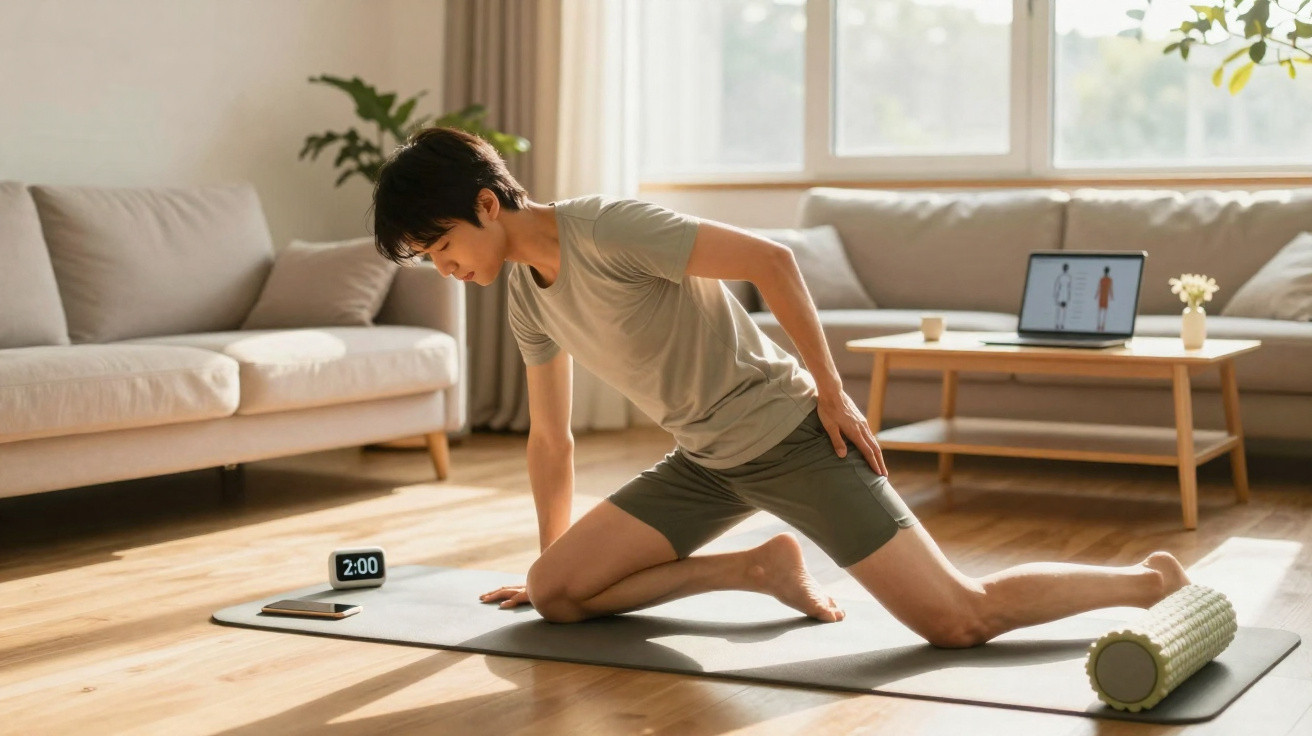
In yoga, this stretch is called Low Lunge, or a half runner’s lunge, but here it is used in a gentler, everyday version. You will need a firm surface and, if necessary, a mat or folded towel. Stand up and take a long step forwards with your right foot, keeping your left foot behind you on its toes. Carefully lower your left knee to the floor, with padding underneath if needed. Keep your torso upright and rest your hands on your front thigh.
Here is the crucial part: do not force yourself forwards until it feels as though something might tear. Instead, gently tilt your pelvis backwards, as if you were drawing your navel towards your spine, and let your hips slowly sink forwards until you feel a pull at the front of your left hip. It should not be a sharp pain, but a clear and controlled stretch. Hold the position for 45–60 seconds while breathing calmly. Then switch legs. That is it: two minutes.
Many people make the same mistake with hip stretches: they do too much, too intensely and too infrequently. We tend to live in an all-or-nothing mode: either we follow a 90-minute app workout, or we do nothing at all. The body works differently. It responds well to small, repeated prompts. If you add this 2-minute stretch once or twice a day – after brushing your teeth, before bed or while the coffee is brewing – your musculoskeletal system will quietly begin to adapt.
There is one common pitfall: many people mistake tension in the lower back for a stretch in the hip. If you drop into a hollow back by leaning your upper body backwards, the pressure goes into the lumbar area rather than the hip flexor. Imagine gently drawing your ribs towards your pelvis and keeping your spine neutral. Breathing helps too: create length on the inhale, then sink a fraction deeper into the stretch on the exhale. It is not a competition or an act of heroism. It is simply you giving two minutes of attention.
A sports medicine doctor once put it this way:
“The hip responds exceptionally well to small rituals. Anyone who lengthens their hip flexors for 60 seconds on each side every day can often save themselves months of conversations about back pain.”
For the 2-minute stretch to make a genuine difference, this quick checklist can help:
- Choose a fixed time of day, such as immediately after brushing your teeth
- Stretch only as far as you can still breathe calmly
- Hold each side for at least 45 seconds
- Gently tilt the pelvis backwards; do not arch your lower back
- A light daily stretch is better than pushing “to the limit” once a week
What these two minutes can change throughout your day
You will rarely notice the effect of this small ritual in the first minute; it is more likely to become apparent over the hours that follow. The walk to the station may suddenly feel less laborious. Your stride becomes slightly longer, and your lower back no longer complains every time you get up. People who run or cycle regularly sometimes find that their legs move more freely, as if someone had switched an internal setting to “unlock”.
There is also a subtle mental element. In a daily routine that is often dictated by outside demands, two minutes spent consciously noticing your body can feel like a small act of rebellion. No timer, no meeting, no notification. Just 120 seconds in which you release one very specific area of tension. Many people say they also feel a little clearer mentally after a hip stretch. Hips and the nervous system are more closely connected than you might think.
Ultimately, the bigger question is less “Does this stretch really work?” and more: “Am I willing to give my body these two minutes every day?” There is no fitness subscription, no pressure to be perfect and no glossy workout involved. It is simply a realistic agreement with yourself. And, in a way, it also poses a quiet question about how we want to treat ourselves: with harshness, or with small, kind rituals that can easily slip into the day.
| Key point | Detail | Benefit for the reader |
|---|---|---|
| Cause of tight hips | Prolonged sitting, inactive glutes, shortened hip flexors | Understands why the hip feels “stuck” and that it is not a personal failing |
| 2-minute stretch | Modified Low Lunge, 45–60 seconds per side, once a day | Gets a specific mini-routine that can be put into practice immediately |
| Making it part of daily life | A fixed trigger (brushing teeth, coffee, end of the working day), gentle execution | Learns how an exercise can become a lasting ritual that works over time |
FAQ:
- How quickly will I notice effects from the 2-minute stretch? Many people feel a slight release after only a few days, while more noticeable changes generally appear after two to four weeks of regular practice.
- Can I do the stretch at work too? Yes. With a soft surface under your knee, it also works in the office; if necessary, you can adapt it slightly on a carpet or even carry it out in the meeting room.
- What if I develop knee pain? Add more padding under the knee, shorten the step slightly and only move as far into the stretch as feels comfortable; if pain continues, it is best to have it assessed by a doctor or physiotherapist.
- Is this one stretch enough to keep my hips healthy? It is a good starting point and can relieve a great deal of pressure, but in the long term hips also benefit from walking, light strength training and varied movement.
- Should I stretch before or after exercise? For most people, the 2-minute stretch is better after exercise or at quieter times of day, because the muscles are already warm and can release more easily.

Comments
No comments yet. Be the first to comment!
Leave a Comment