
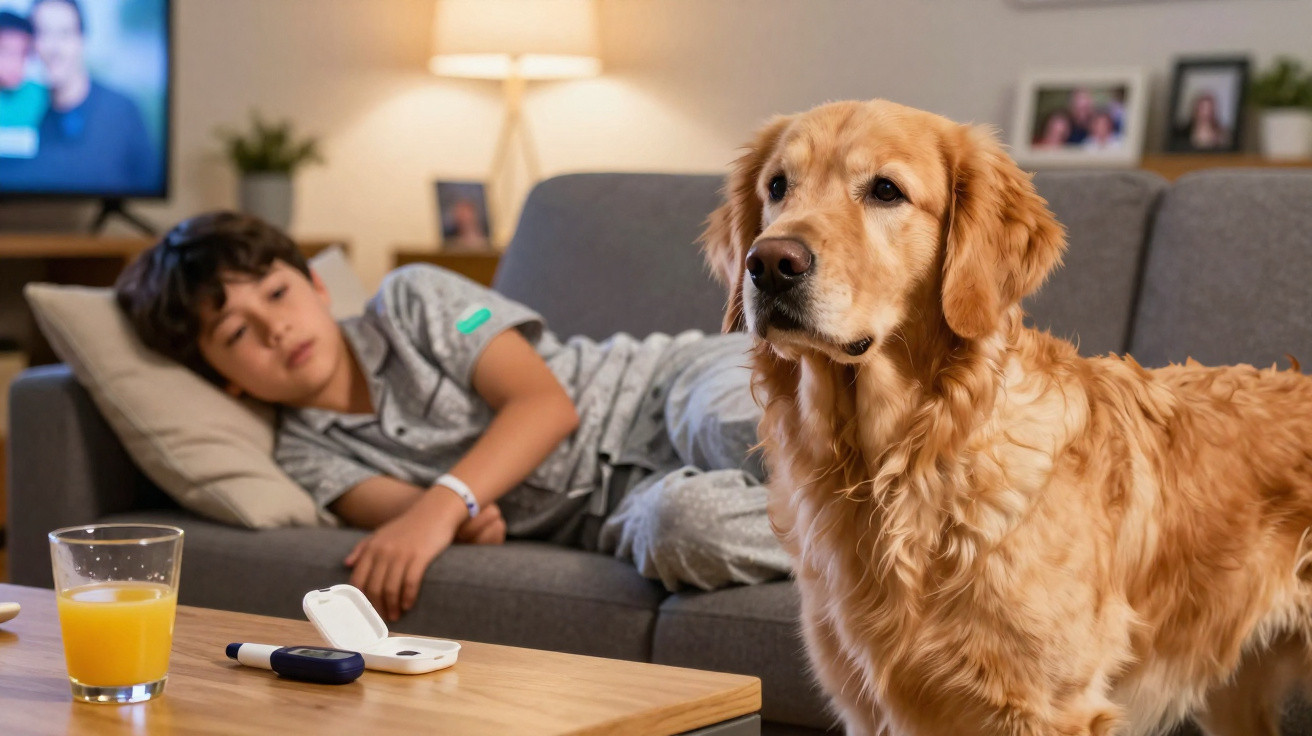
A short video from the living room of an American family is currently moving millions of people on social media. It features a child with Type 1 diabetes and his assistance dog. What initially appears to be an innocent everyday scene proves to be a quiet medical miracle.
An ordinary evening watching television – until the dog reacts
The boy is sitting on the sofa watching television. There is no obvious sign that his body may be in danger. However, the dog notices something no person can see. In footage posted on the Instagram account “TypeONEderfulWells”, the four-legged companion suddenly starts pacing restlessly around the boy.
He sniffs, dances about and seems unable to settle. To anyone watching from outside, it might look like playful behaviour – but the family recognises it as an unmistakable warning. The dog is signalling: attention, the blood glucose level is wrong.
The assistance dog detects the impending danger before either the boy himself or a measuring device notices it.
Soon afterwards, the family checks his blood glucose. Their suspicion is confirmed: the readings are in a range that could become dangerous. Because of the prompt alert, they can take action, preventing a possible emergency.
After the alert comes comfort: the dog reassures his “human child”
Once the dog has completed his task, his alarm response turns into affection. The video shows him pressing close to the boy. He gently rests his head on the child’s knee and stays right by his side.
The gesture appears almost human. It makes clear that this is about more than training and conditioning; it is also about a bond. The dog calms the child, offering reassurance and normality in a situation that is seriously concerning beneath the surface.
Alert, protect, comfort – for many families living with Type 1 diabetes, the dog has long been more than “just” an animal.
What do diabetes alert dogs actually do?
These animals receive specialised training to detect changes in the bodies of people with Type 1 diabetes. They are regarded as “living sensors”, working alongside technology and medical care.
How dogs sniff out dangerous blood glucose levels
Rather than relying on equipment, the dog uses its sense of smell. When a person’s blood glucose rises or falls sharply, metabolic changes alter scent compounds, including those in breath and sweat. Humans cannot detect them, but dogs can.
- They identify unusual scent patterns that may indicate hypoglycaemia or hyperglycaemia.
- They are trained beforehand to connect these smells with a particular action.
- They communicate the change through agreed signals, such as nudging, barking or circling.
Many alert dogs respond before a measuring device reports a critical reading or before early physical symptoms, such as shaking, sweating or confusion, occur. This can be life-saving in quiet everyday settings – while sleeping, reading or, as in this case, watching television.
Typical duties of a diabetes assistance dog
Depending on its training, a dog like this can carry out several roles:
- Early detection of low and high blood glucose
- Waking someone when readings become dangerous during the night
- Alerting parents, partners or housemates
- Fetching glucose tablets, a glucose meter or an insulin pen
- Providing emotional support during stressful periods of the condition
The dog does not replace medical treatment, but adds an extra layer of safety to everyday life.
Why videos like this affect so many people
In just a few seconds, the living-room clip demonstrates how closely modern medicine, animal training and everyday life can work together. Many users have responded with emotional comments, shared their own experiences or described how their pets have “accidentally” alerted them to illnesses.
Stories of this kind are increasingly common: dogs that persistently sniff one particular area, where a tumour is later discovered; animals that behave unusually shortly before their owner collapses. Such accounts can be difficult to grasp for people who think in strictly scientific terms, but for those affected, they are reality.
More than viral content: everyday life with Type 1 diabetes
Behind the touching video lies a demanding diagnosis. Type 1 diabetes affects a child around the clock. Parents must constantly plan ahead: checking blood glucose, giving insulin injections, calculating carbohydrates, and accounting for sport and stress. Undetected hypoglycaemia can become life-threatening within minutes, especially at night.
A well-trained dog can ease some of the pressure within this system. It stays awake when a person is tired and remains alert when concentration fades. It signals when something starts to go wrong. This does not mean parents or people with diabetes can become carefree. Yet the burden is shared by more shoulders – or, more accurately, four paws.
How a dog becomes a medical helper
The path to a dependable alert dog is lengthy and costly. Specialist trainers often begin with young dogs that are especially attentive, steady-natured and people-focused. Breeds such as Labradors and Golden Retrievers are often well suited, but temperament matters more than appearance.
During training, the dog first learns basic obedience and how to cope safely with daily life. Only then does the medical training begin. Scent samples reflecting different blood glucose levels are used, initially with plenty of rewards and clear cues. Gradually, the dog links scent and action: “If I smell THAT, I must respond.”
Later, the dog and person practise together. The four-legged companion joins its person in daily life while trainers correct and reinforce its behaviour. The aim is for the dog to alert reliably even in unfamiliar environments – at school, in the supermarket or while visiting friends.
Limits and risks of this four-pawed support
As remarkable as these abilities may be, a diabetes alert dog is not a medical device with a guarantee. Mistakes are still possible. A dog may be wrong or become unable to respond in stressful situations. People with Type 1 diabetes must therefore never rely solely on the animal.
Experts emphasise three key points:
- Regular blood glucose checks and medical monitoring remain essential.
- The dog is an addition, not a replacement for sensors or insulin therapy.
- The standard of training determines reliability and safety.
Anyone considering bringing such a dog into their family should look for certified trainers, ask to see references and carefully assess whether the animal suits the family’s everyday routine. An assistance dog requires time, care and continued training – and places considerable demands on its handlers.
Why children in particular benefit from alert dogs
Blood glucose levels often fluctuate more strongly in children than in adults. Growth, sport, stress at school and irregular meals can all alter insulin requirements. It is difficult for parents to keep track of everything around the clock. A dog that flags unusual readings early can be a valuable partner.
At the same time, the four-legged companion can have a psychological effect. Many children feel “different” or limited by their condition. Having their own assistance dog can transform that feeling: suddenly, the illness is no longer the focus, but rather the team formed by child and dog. This can build confidence and personal responsibility.
The dog reminds them to test and eat – without a wagging finger, only with its nose and paw.
Diabetes in everyday life: technology, training and animal as a team
Modern sensors, insulin pumps and apps make managing Type 1 diabetes considerably easier. They measure, calculate and issue digital warnings. A dog adds another dimension: it responds to smells, behaviour and mood. It does not just pay attention to the glucose reading, but to the whole person.
That combination is precisely what makes the living-room clip so powerful: medical devices are presumably also monitoring the readings. Yet in this moment, it is the dog that raises the alarm first, keeps watch over the child and stands directly in front of him. This blend of technology and animal, measurement and closeness, shows how life with a chronic condition can feel more human.
The video’s viral success has one further effect: many people are hearing about diabetes alert dogs for the first time. Families who previously knew only sensors and glucose meters are learning that other options exist for improving safety and quality of life. Not every family will be able to choose, or want, an assistance dog. But the idea that an animal can offer such precise help changes how people view diabetes – and what a dog can achieve.






Comments
No comments yet. Be the first to comment!
Leave a Comment