
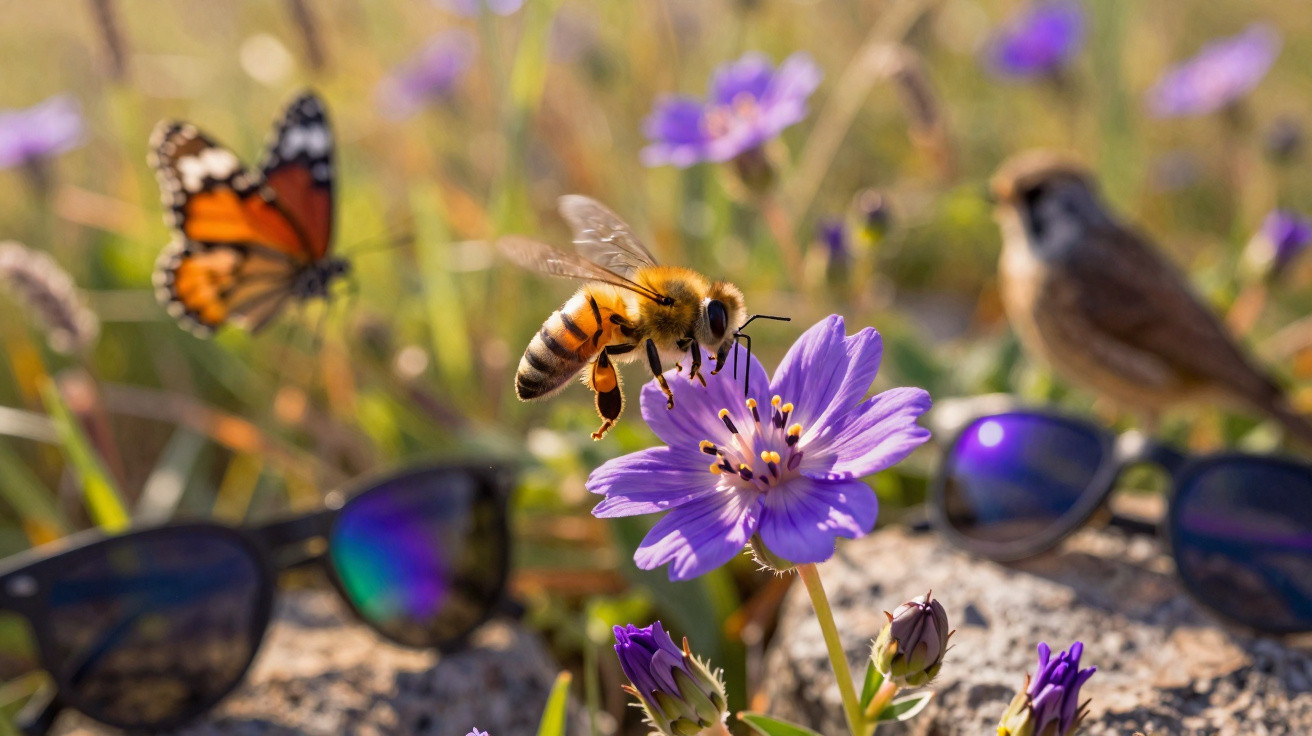
An apparently ordinary flower may contain markings that no human can see with the naked eye. To a bee, however, these patterns can act as genuine signposts. This is possible because many animals can detect ultraviolet light, a part of the spectrum that surrounds us while remaining entirely invisible to human vision.
Why are humans unable to see ultraviolet light?
Human sight relies chiefly on three types of cones, each responsive to different portions of visible light. In addition, structures such as the lens filter out much of the ultraviolet radiation before it can reach the retina. As a result, wavelengths below violet do not register as a colour to us.
For many animals, the situation is different. Animal-vision research shows that some species have ultraviolet-sensitive photoreceptors as well as eyes that allow this radiation to reach the retina. Studies of birds, for instance, have identified visual pigments specialised for wavelengths of around 360 to 373 nanometres.
Which animals can see what humans cannot?
This ability occurs across remarkably varied groups. Bees, numerous birds, some fish, reptiles and even certain mammals can detect at least part of ultraviolet radiation. Consequently, objects that look like one uniform colour to humans may display entirely different contrasts and patterns to these animals.
- Bees detect ultraviolet light and use signals found in flowers while foraging.
- Many birds have colour vision based on four cone types rather than the three present in humans.
- Reindeer can perceive ultraviolet light even in the Arctic's extreme lighting conditions.
- Some lizards have eyes that allow ultraviolet wavelengths to pass through to the retina.
Among birds, the contrast can be particularly striking. Scientific reviews describe many species as tetrachromatic, meaning that they can combine information from four classes of cones. A bird's visual experience may therefore include colour distinctions with no direct equivalent in human perception.
How does ultraviolet vision help a bee find flowers?
Some flowers reflect ultraviolet light unevenly, producing patterns that can guide pollinators towards areas containing nectar and pollen. These markings remain concealed from us. For a bee, they form part of the range of colours and contrasts used to recognise and choose flowers while flying.
This does not mean that bees merely see a more colourful version of what humans see. Their visual system differs from ours and lacks the same sensitivity to red. Nature therefore offers different visual maps for each species, according to the receptors in its eyes and the needs shaped throughout evolution.
Watch the video shared by the INCREDIBLE YouTube channel, showing how the world is seen through the eyes of other animals.
Can mammals see ultraviolet light too?
Although this ability is less widespread among mammals, reindeer provide a notable example. Research indicates that their eyes permit ultraviolet light to enter, a feature that is especially valuable in the Arctic, where snow reflects large amounts of this radiation at certain times of year.
Studies suggest that this form of vision may improve the contrast of important features in the environment. Lichens eaten by reindeer absorb ultraviolet light and may look darker against the snow, making them easier to find. The same ability may also assist in identifying other objects that are difficult to distinguish in a landscape that is almost wholly white.
How much of the world around us remains invisible?
Ultraviolet light makes it clear that what we call visual reality is only a limited interpretation of our surroundings. Flowers, feathers and surfaces that appear plain to our eyes may carry signals used for feeding, mate selection, communication or survival by species capable of perceiving different wavelengths.
The more scientists investigate these sensory systems, the clearer it becomes that we do not see the world as it truly is, but as our eyes are able to translate it. The next time you look at a flower or a bird, it is worth remembering that a whole layer of visual information may be unfolding in front of you without you being able to perceive a single one of its colours.





Comments
No comments yet. Be the first to comment!
Leave a Comment