
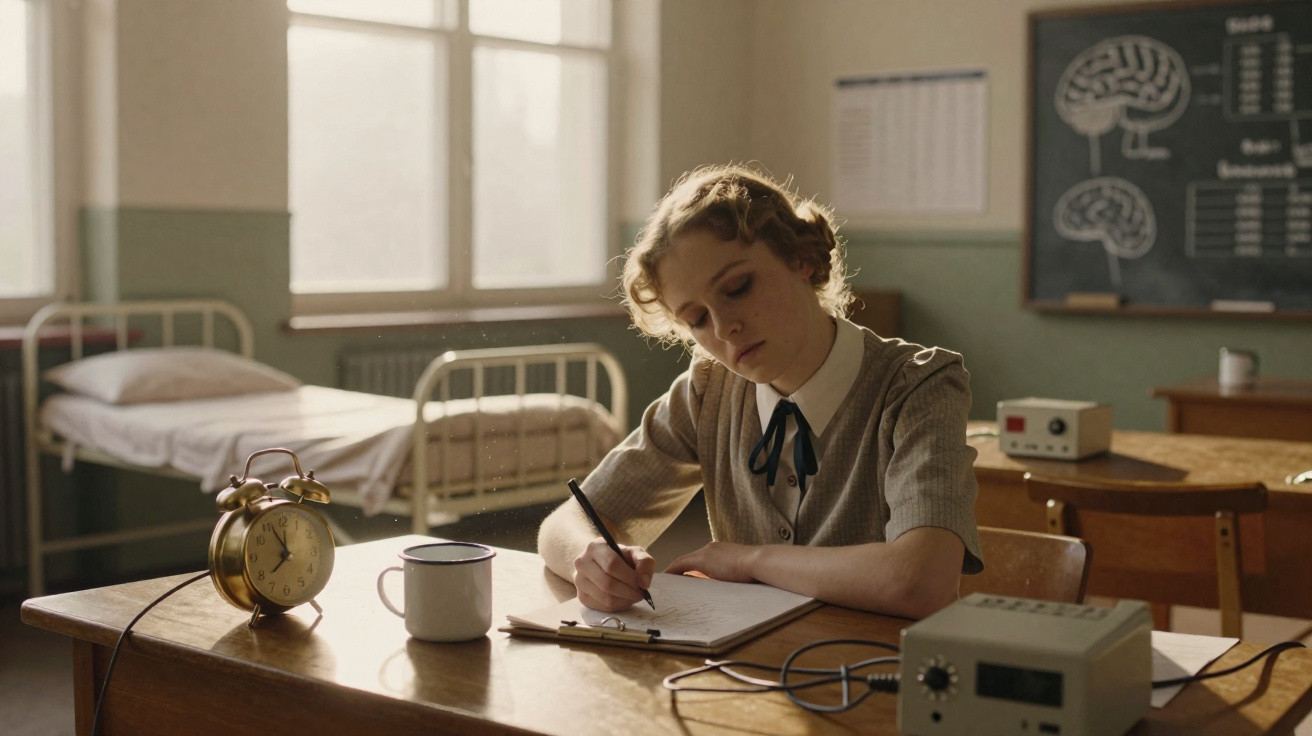
In a bustling Washington summer, an unlikely experiment put the very act of sleeping on trial in both scientific and cultural terms.
As factories belched smoke and electricity reshaped cities, one professor decided to test an almost sacred limit: do human beings truly need sleep?
A Washington laboratory challenges the habit of sleeping
It was the summer of 1925 in Washington. In the halls of George Washington University, psychology professor Frederick August Moss promoted a bold theory: sleep was merely an inherited habit, wasting a third of people’s lives. In his view, trained individuals could virtually eliminate sleep and gain extra productive hours.
To demonstrate his argument, Moss brought together seven student volunteers in his Foggy Bottom laboratory. Their assignment was easy to describe but difficult to endure: remain awake for 60 consecutive hours. That meant two and a half days without properly closing their eyes, under continuous supervision.
The experiment promised to answer an uncomfortable question: is sleep a biological necessity or simply a cultural crutch?
In an age captivated by speed and efficiency, the proposal fitted perfectly. The United States celebrated the frantic pace of factories, cars were taking over the streets, and figures such as Thomas Edison had become symbols of tireless commitment. Edison boasted that he slept only four hours a night. Moss wanted to prove that this routine could become the rule rather than the exception.
The seven volunteers and a bed-free weekend
The participants were young, healthy and inquisitive. They included 22-year-old Thelma Hunt and her fellow student Louise Omwake. Neither could have imagined that the weekend would become a landmark in their paths through psychology.
The protocol was improvised yet carefully managed. To stay awake, the students rotated through several activities:
- Extended discussions in the laboratory to stimulate their thinking;
- Car journeys through rural Virginia, with the windows down and wind on their faces;
- Informal baseball games to keep their bodies active;
- Short tests and practical assignments carried out under the professor’s watch.
Between cups of coffee, Moss gave them memory, arithmetic and reasoning tests. He timed their reflexes, organised attention exercises and asked them to perform delicate motor tasks, such as parking a car without touching the kerb. As the hours passed, their performance began to deteriorate.
Their scores fell and mistakes multiplied, yet no one collapsed. To Moss, that sounded like a victory: the body could endure more than it appeared to.
For the professor, the fact that none of the volunteers fainted or broke down suggested that sleep could, at least partly, be overcome. It was a matter of habit, training and willpower. Science, however, was not moving entirely in the same direction.
The clash with other sleep deprivation research
That same year, 1925, a University of Chicago laboratory released very different findings. Its researchers concluded that cutting back on sleep seriously harmed health, with no reliable shortcut around the problem. Every attempt to “trick” the body came with physical and mental consequences.
These findings supported a consensus that was beginning to gather strength: altering the amount of sleep meant interfering with deep brain processes. Less rest translated into unstable moods, memory lapses, poorer judgement and physiological changes.
| Decade | Dominant idea about sleep | Current scientific view |
|---|---|---|
| 1920s | Sleep regarded as a habit that could be reduced through training | Hypothesis considered simplistic and biologically unsustainable |
| 1950s | Recognition of sleep cycles and distinct stages | Foundation for understanding sleep’s restorative and cognitive role |
| Today | Emphasis on sleep quality, duration and regularity | Sleep understood to be a health factor as important as diet |
Definitive confirmation would arrive decades later, again from Chicago. During the 1950s, Nathaniel Kleitman and Eugene Aserinsky identified sleep cycles and so-called REM sleep, marked by rapid eye movements and intense brain activity. From that point, night-time rest was no longer viewed as a simple “switching off”, but as an active and sophisticated state.
During the night, the brain reorganises memories, strengthens neural connections and regulates hormones linked to appetite, stress and mood.
When productivity becomes an obsession against sleep
Viewed today, the 1925 experiment seems almost like a metaphor for the modern obsession with performance. That Washington laboratory already contained the beginnings of many ideas now repeated in corporate self-help discourse: work more, sleep less and “optimise” every minute.
Current research paints a different picture. Over the long term, short nights and fragmented sleep:
- raise the risk of type 2 diabetes through disrupted glucose regulation;
- encourage weight gain by changing hunger and satiety hormones;
- weaken the immune system;
- increase the likelihood of depression and anxiety;
- are associated with a greater risk of cardiovascular disease.
Studies involving large populations also reveal an intriguing pattern: people who sleep too little and those who sleep too much both appear more frequently in illness and mortality statistics. When sleep hours are compared with health indicators, the relationship tends to form a “U” shape.
That does not mean excessive sleep directly causes disease. Often, prolonged sleep signals another underlying issue, such as sleep apnoea, depression, metabolic disorders or chronic inflammation.
From the 1925 laboratory to today’s “sleep hygiene”
If the aim then was to prove that sleep was dispensable, the focus today is on the quality of that rest. There is even a technical term for it: “sleep hygiene”. It describes a set of habits that promote stable nights.
Among the recommendations most often cited by researchers are:
- Keeping relatively consistent bedtimes and waking times, including at weekends;
- Reducing bright light and screens at least 30 to 60 minutes before going to bed;
- Avoiding very heavy meals late in the evening;
- Keeping the bedroom dark, quiet and slightly cool;
- Reserving the bed for sleep and intimacy rather than working there.
If the challenge in 1925 was to see how far the body could go without sleep, today the question has become: how can we create the best conditions for sleep to happen properly?
The forgotten figures: students who became leading psychologists
Amid the curious history of sleep deprivation, two central figures can easily be overlooked: Thelma Hunt and Louise Omwake. The two young women who agreed to remain awake for 60 hours went on to notable careers in psychology.
Hunt would become a pioneer in educational research and psychological assessment. Omwake would eventually lead the psychology department at the same university. In a male-dominated field, both created opportunities for women in academic research, at a time when even taking part in an experiment was an act of assertion.
This detail adds another layer to the 1925 episode. The study was not only a radical test involving sleep. It was also a moment when young female researchers began to take centre stage in a changing discipline.
Why 60 hours without sleep affects the body so deeply
For anyone wondering what happens in practical terms when someone stays awake for 60 hours, modern science provides a fairly clear picture. In such a situation, it is common to experience:
- intense irritability and sudden mood changes;
- a marked decline in sustained attention;
- basic mistakes in simple tasks, such as driving or typing;
- microsleeps, those seconds-long “blackouts”, even with the eyes open;
- difficulty consolidating new memories;
- greater impulsiveness and poorly considered decisions.
In extreme and extended situations, hallucinations can occur. Deprived of rest, the brain begins to blend memories, external stimuli and imagination. It is no accident that many laws treat exhausted drivers in much the same way as drink drivers.
For people whose lives involve shift work, medical on-call duties, night-time side jobs or prolonged study, this picture serves as a warning. The effect is not confined to radical laboratory experiments. It accumulates through small sleep debts, week after week.
What this story still teaches about our relationship with rest
The 1925 experiment is a reminder that the way we view sleep is profoundly cultural. In certain professional settings, sleeping for longer is still treated as weakness or a lack of ambition. Science, by contrast, has been moving in the opposite direction.
One possible outcome, had Moss’s reasoning prevailed, would be a society that normalised endless working hours and minimal rest. Digital platforms, 24-hour deliveries and permanent remote working would all quickly adapt to an ideal of constant wakefulness. The health cost, however, would be enormous, including more workplace accidents, family conflicts and silent epidemics of depression and burnout.
Terms such as “sleep debt”, “chronotype” and “social jet lag” are already part of the vocabulary of laboratories and clinics. Sleep debt is the accumulation of hours the body “should” have slept but did not. Chronotype describes a person’s natural tendency to be more active in the morning or at night. Social jet lag arises when an imposed routine, such as fixed working hours, remains in permanent conflict with that internal clock.
Looking back at the students who stayed awake for 60 hours helps frame the discussion differently. It is not simply about how many hours can be taken from the night, but what kind of life we are prepared to lead when rest becomes a bargaining chip.






Comments
No comments yet. Be the first to comment!
Leave a Comment