
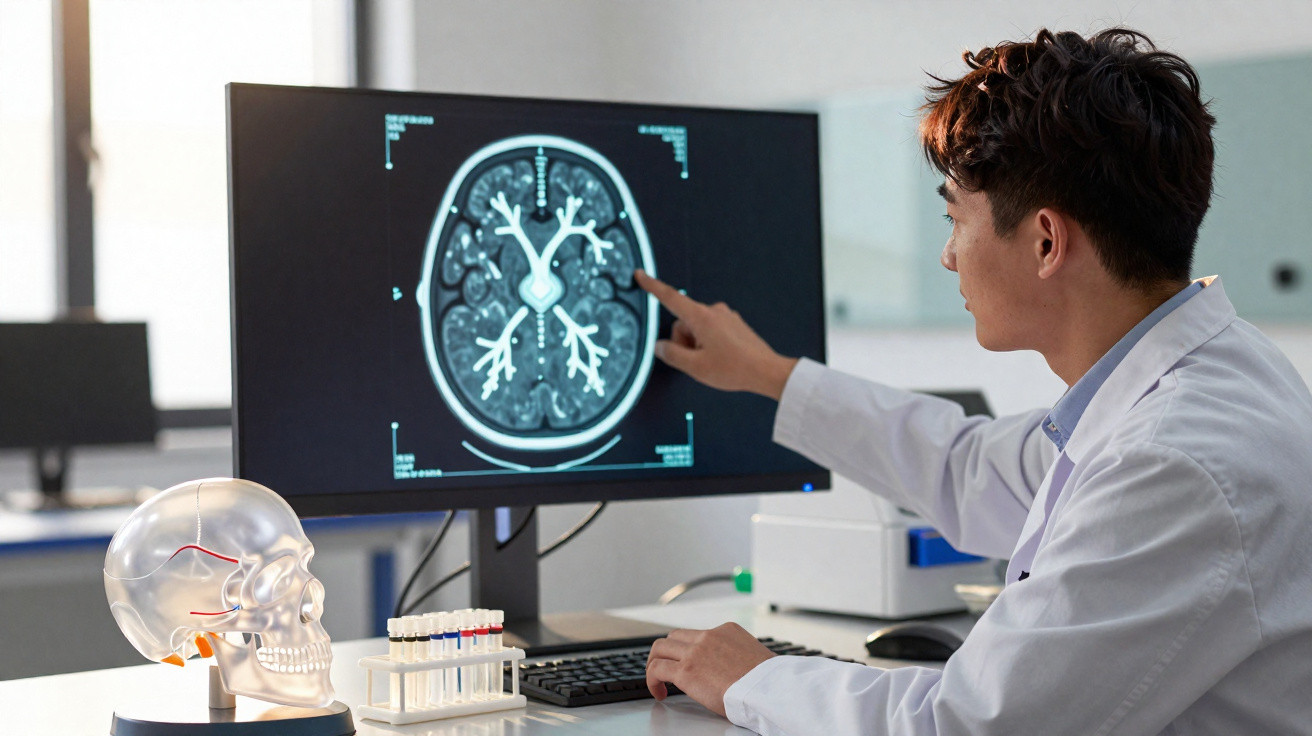
For many years, scientists believed that immune cells made in bone marrow travelled to the brain only when it required protection against injury or infection.
That view changed in 2018, when researchers identified a concealed shortcut within the skull.
Evidence revealed minute channels linking bone marrow in the skull with the membranes surrounding the brain. The discovery indicated that the skull may possess its own rapid-response routes for immune activity.
Since then, researchers have uncovered more about these puzzling links between skull bone marrow and the brain. Recent evidence now indicates that this hub of immune activity could also have a role in disease.
Skull bone marrow and chronic pain
A study led by Harvard Medical School researchers and published in Science Translational Medicine suggests that skull bone marrow may also be important in people living with chronic pain.
Earlier research involving some members of the same team found indications of increased concentrations of a protein known as translocator protein (TSPO) near skull bone marrow in people with migraine and visual aura.
TSPO is plentiful in immune cells within bone marrow. Those findings implied that an immune response arising in skull bone marrow could somehow contribute to migraine attacks.
"Similar findings in neurodegenerative and psychiatric diseases such as Alzheimer's disease, stroke, depression, and autism suggest that skull marrow activation might not be unique to migraine but may instead represent a more fundamental neuroimmune response shared across diverse neuroinflammatory conditions," the researchers, led by clinical imaging scientist Mehrbod Mohammadian, explain in their paper.
TSPO patterns in PET/MRI scans
To explore the question in more detail, the team assessed PET/MRI brain scans from 125 adults with chronic pain: 88 people with chronic back pain and 37 with knee osteoarthritis. They compared these scans with those of 22 healthy participants, who formed the control group.
Across extensive areas of the skull, participants with chronic pain had greater TSPO levels than the healthy controls. The increases were particularly marked in the frontal and parietal parts of the skull.
Although raised TSPO levels were detected in both chronic-pain groups, the signal was strongest among participants with knee pain.
In the PET data, stronger TSPO signals were associated with more intense pain and greater pain interference with everyday life, based on participants' questionnaire responses.
Through several types of analysis, the researchers also identified differing indicators that connected TSPO levels with anxiety, depression and pain burden.
Donated tissue and possible immune activity
To support the brain-scan findings, the researchers carried out a separate examination of donated skull tissue from two deceased men, both aged 62. One had experienced chronic pain, whereas the other had reported no such problems.
The skull bone marrow tissue from the donor with chronic pain contained more than twice as many cells overall as the control donor's sample: 3,826 cells compared to 1,616 cells. It also had a greater proportion of TSPO-positive cells, at 82 percent compared to 55 percent.
The researchers caution that the post-mortem findings are preliminary. However, when considered alongside the associations identified in the brain data, they suggest that immune-response activity involving skull bone marrow is connected with chronic pain.
"These findings provide a strong rationale for further investigating this previously overlooked structure, which remains largely under-explored in the context of pain," the researchers write, proposing that treatments designed to target or stimulate skull bone marrow may be worth investigating as a way to relieve pain.
The researchers say the cellular activity that might explain the pain remains unknown, but they propose that "mechanisms linked to skull-to-brain neuroimmune cross-talk" are involved in some way.
The team speculates that immune signals beginning in the brain could travel to skull bone marrow via the skull-meninges channels. This could activate skull bone marrow immune cells, known as myeloid cells, causing them to mobilise and potentially resulting in neuroinflammation further downstream.
As this was an observational study, it cannot establish whether activity in skull bone marrow helps cause chronic pain, or whether the relationship operates in the opposite direction.
Something appears to be happening, but further research will be needed to provide clearer answers.
The findings are reported in Science Translational Medicine.
This article was fact-checked by Clare Watson and edited by Clare Watson. Although we take pride in our process, we are only human. If you notice an error, please let us know.






Comments
No comments yet. Be the first to comment!
Leave a Comment