
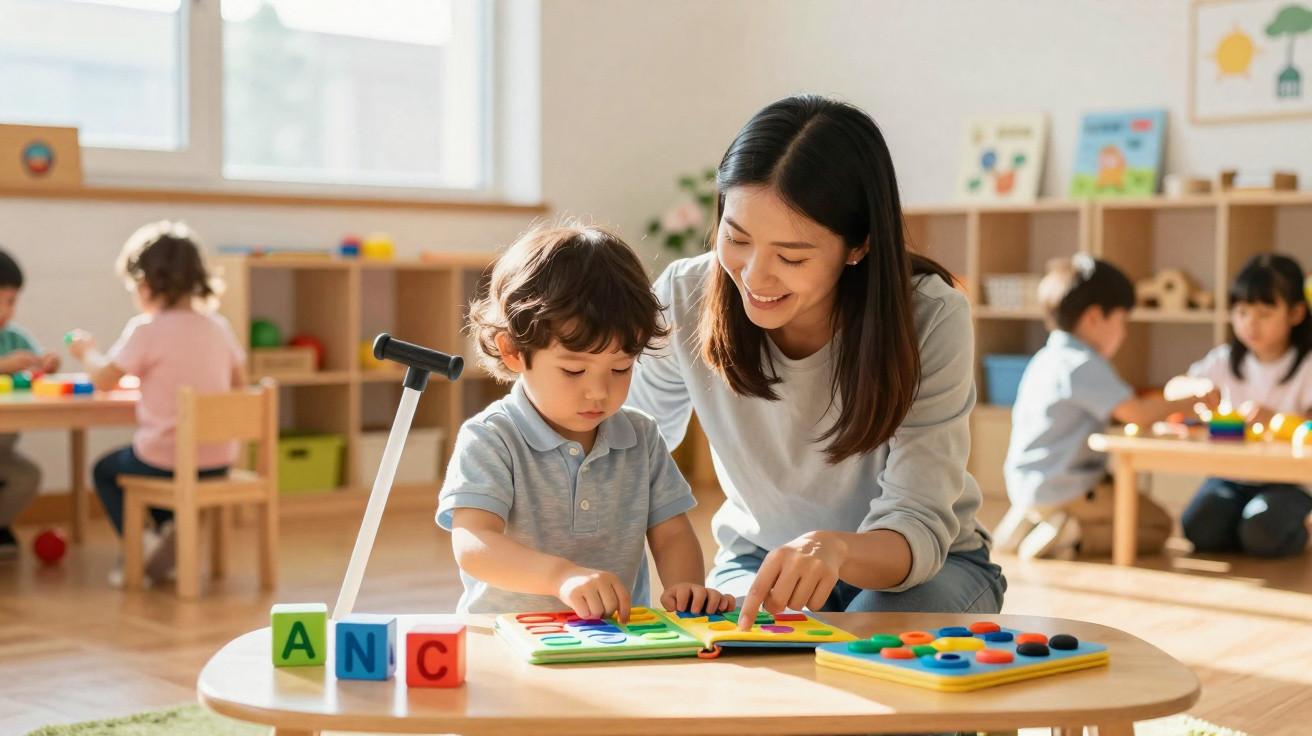
National Early Childhood Education Day, observed on 25 August, is an opportunity to consider the importance of ensuring every child can access learning experiences from their earliest years. Established by Law No. 12,602/2012, the date highlights the significance of this stage for child development and creates room to address the challenges of inclusion.
For blind children and those with low vision, full participation in early childhood education experiences requires consideration of different ways of learning, playing, exploring and engaging with the world. Accessible teaching materials, assistive technology resources, appropriate stimulation and well-prepared professionals are among the factors that can help ensure these children have the same opportunities for development and learning.
The educational challenges experienced by people with disabilities, including visual impairments, remain substantial. According to 2022 Census data released by the Brazilian Institute of Geography and Statistics (IBGE) in 2025, 21.3% of people with disabilities aged 15 or over were illiterate, a rate four times higher than that recorded among people without disabilities (5.2%). In addition, 63.1% had no formal education or had not completed primary education, compared with 32.3% of people without disabilities.
This is why inclusion must be considered from early childhood. The earlier a child can access resources that respect their needs and potential, the greater their chances of developing autonomy, communication and the skills needed to participate actively in school and social life.
Inclusion and development from childhood
A leading organisation supporting children, young people and adults with visual impairments, Laramara – Brazilian Association for Assistance to People with Visual Impairments has worked for more than three decades to promote inclusion and broaden access to resources and strategies that support development. Founded in 1991 by Mara and Victor, the organisation was created after their daughter, Lara, was diagnosed with retinopathy of prematurity. Seeking ways to support her daughter, Mara specialised in special education, gaining qualifications in Pedagogy and a specialism in blindness and visual impairment at the University of São Paulo (USP).
Today, Laramara runs initiatives focused on inclusive education, professional training, access to assistive technologies, the development of children and young people, family support and institutional coordination. Its work also includes courses for education professionals and therapists, helping to expand knowledge of visual impairment and improve the support provided to this group.
“During early childhood, much of the experience that drives development takes place through play, exploring one’s own body, objects and spaces, and interacting with other people. For a child with a visual impairment, ensuring access to these experiences is essential so that they can participate actively, build knowledge, develop autonomy and broaden their understanding of the world,” says Junia Buzim, an educationalist at Laramara.
Professional training strengthens inclusion
In this context, inaccessible materials, poorly planned environments and a lack of professionals equipped to understand the specific aspects of visual impairment can still create barriers to participation and learning. Therefore, the ongoing training of education professionals is essential, enabling them to recognise potential and needs, identify barriers and develop teaching strategies that increase opportunities for interaction, communication and learning.
“A truly inclusive early childhood education does not offer a separate experience; it ensures that a child with a visual impairment genuinely takes part and has real opportunities to develop,” the educationalist notes.
By Juliana Vaz






Comments
No comments yet. Be the first to comment!
Leave a Comment